June 2014

KADUNA, Nigeria (AP) — By the time she ran away, she bore the scars of an abused woman anywhere - a swollen face, a starved body, and, barely a year after her wedding, a divorce. But for Maimuna Abdullahi, it all happened by the time she was 14.
Maimuna is one of thousands of divorced girls in Nigeria, who were forced into marriage and have since run away or been thrown out by their husbands. They are victims of a belief that girls should get wed rather than educated, which led
Boko Haram terrorists to abduct more than 200 schoolgirls two months ago and threaten to marry them off.
"I'm too scared to go back home," Maimuna whispers, as she fiddles nervously with her hands. "I know they will force me to go back to my husband."
Her former husband, Mahammadu Saidu, 28, does not deny beating her, and blames her few years of school for her disobedience.
"She had too much ABCD," he says. "Too much ABCD."
Nigeria has one of the highest rates of child marriage in the world, despite a law that sets the age of consent at 18. The custom of child marriage is still ingrained enough that even a federal senator has married five child brides and divorced one.
Across the country, one in five girls marry before 15, according to the United Nations. In the poor Muslim north, where child marriage is often considered acceptable under shariah or Islamic law, that number goes up to one in two. Some child brides are as young as 9.
There are no official numbers for just how many of these girls get divorced, leaving them destitute, but they are all too visible. A few miles away, girls Maimuna's age and younger are selling their bodies to truck drivers.
"Nobody knows how many thousands of them there are," says Saadatu Aliyu, the founder of a private school for divorced girls that Maimuna now attends. "That's why we have so many prostitutes, and very young ones, in the north."
At 45, Maimuna's father, Haruna Abdullahi, has been married for 30 years and has fathered eight children. He says his culture allows girls to go to their husband's houses from the age of 12. His wife, Rabi Abdullahi, was a child bride, although she does not know exactly how old.
"It is our way of life," she says. "In my day, a bride would never dare to run away."
In this desperately poor region, a child marriage brings in a bride price and means one less mouth to feed. So in late 2012, Maimuna's father arranged to marry his eldest daughter to his best friend's eldest son. The son, Saidu, paid a dowry of $210 — more cash than Abdullahi has had in his life.
She was 13, he twice her age. Saidu, a farmer, says he waited years for Maimuna to reach what he considers marriageable age.
"When she was a kid, I would bring her candy and call her 'wifey,'" says Saidu, who cannot read or write. "We were always meant to be together."
Maimuna begged her father to let her stay in school, but her wishes were not up for discussion. The link between child marriage and education is clear: Only 2 percent of married girls in Nigeria go to school, compared to 69 percent of unmarried girls. Three out of four married girls cannot read at all.
Many of Maimuna's friends from school were already married, and not one was happy. She got no advice, on warning of what to expect from the marriage bed.
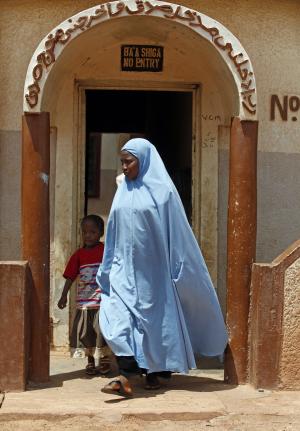
In this Saturday, May 31, 2014 photo, Maimuna Abdullahi, …She settled into a new life where she worked in the fields, cleaned, carried water and firewood and cooked. Every day she was exhausted, and when she finally got to bed, her husband wanted to "bother" her, she says. He never kept his promise to let her go to school. When she objected to her treatment, he locked her into their hut, for days.
Nine months ago, she fled to her father and begged to return home. Instead, he whipped her until her back was raw, then forced her to go back to her husband.
Saidu, humiliated and furious, slapped her repeatedly in the face. She fled once again, first to a sympathetic aunt and then to a cousin in Kaduna.
When Maimuna showed up at the Tattalli Free School for divorced girls, she had been badly beaten and refused to speak, says teacher Victoria Dung. Doctors found she was badly malnourished. The whip marks on her back may last a lifetime.
Her husband waited three months to make sure there was no baby. Then he divorced her. Under shariah law, a man can get divorced by declaring the divorce aloud three times.
Maimuna considers herself among the lucky ones because she is back at school.
"I pray that what I have done will help the younger ones, that my parents learn from the experience of my running away from home," she says.
It is by no means certain.
Maimuna's father denies beating his daughter, and says he is happy she is getting educated. Yet he gets visibly angry when he describes the financial problem she has left him.
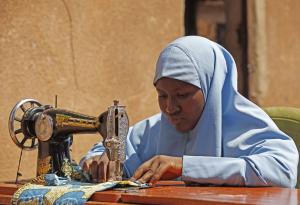
In this Saturday, May 31, 2014 photo, Maimuna Abdullahi …
Saidu is demanding his money back, because he wants to look for another bride. But Abdullahi has already spent it on land. Asked if he will treat his five younger daughters differently, he looks down at the ground.
"I would allow my daughters to go to school if I had the money. I have seen what happens, otherwise," he says. "But my reason is poverty, always financial problems. What can I do but give them out in marriage?"
Saidu, in the meantime, says he will move ahead with his life.
"This time I will marry a girl of 12, so that she will do what I want to do," he says. "Because if you marry a girl who is older, then she will not listen to you."
His eyes slide to the porch, where Maimuna's 10-year-old sister, Hafsat, is cuddling a neighbor's baby. A sly smile curls his lips.

I have had to remain quiet about the continuing efforts by Nigeria’s military, police and investigators to find the girls kidnapped in April from the town of Chibok by the terrorist group Boko Haram. I am deeply concerned, however, that my silence as we work to accomplish the task at hand is being misused by partisan critics to suggest inaction or even weakness.

My silence has been necessary to avoid compromising the details of our investigation. But let me state this unequivocally: My government and our security and intelligence services have spared no resources, have not stopped and will not stop until the girls are returned home and the thugs who took them are brought to justice. On my orders, our forces have aggressively sought these killers in the forests of northern Borno state, where they are based. They are fully committed to defending the integrity of their country.

My heart aches for the missing children and their families. I am a parent myself, and I know how awfully this must hurt. Nothing is more important to me than finding and rescuing our girls.
Since 2010, thousands of people have been killed, injured, abducted or forced by Boko Haram, which seeks to overwhelm the country and impose its ideology on all Nigerians. My government is determined to make that impossible. We will not succumb to the will of terrorists.

A handout photograph made available by the World Economic Forum shows President of Nigeria, Goodluck Jonathan, speaking during the opening plenary session of the World Economic Forum on Africa in Abuja, Nigeria. (Benedikt Von Loebell / World Eco/EPA)
The abduction of our children cannot be seen as an isolated event. Terrorism knows no borders. This month, Nigeria, Benin, Cameroon, Chad, Niger, Britain and the United States established an External Intelligence Response Unit to share security information on such threats in West Africa. I propose that we build on this step to establish an enduring, worldwide commitment to destroying terrorism and those who finance or give safe haven to the terrorists.
In September, I will urge the U.N. General Assembly to establish a U.N.-coordinated system for sharing intelligence and, if necessary, special forces and law enforcement to confront terrorism wherever it occurs.

In Nigeria, there are political, religious and ethnic cleavages to overcome if we are to defeat Boko Haram. We need greater understanding and outreach between Muslims and Christians. We also know that, as it seeks to recruit the gullible, Boko Haram exploits the economic disparities that remain a problem in our country. We are addressing these challenges through such steps as bringing stakeholders together and creating a safe schools initiative, a victims’ support fund and a presidential economic recovery program for northeastern Nigeria. We are also committed to ridding our country of corruption and safeguarding human and civil rights and the rule of law.
Something positive can come out of the situation in Nigeria: most important, the return of the Chibok girls, but also new international cooperation to deny havens to terrorists and destroy their organizations wherever they are — whether in the forests of Nigeria, on the streets of New York or sanctuaries in Iraq or Pakistan. Those who value humanity , civilization and the innocence of children can do no less.


Philani Dladla, a homeless man living on the streets of Johannesburg, is probably the last person you’d expect to be a bookworm. Yet, the 24-year-old is quite a voracious reader. And instead of begging like other homeless people, he has chosen to make a living by reviewing and selling books.


South African director and cinematographer Tebogo Malope played a tremendous part in bringing Philani’s unique and inspiring story to the world. Malope, 29, recorded an interview with Philani
called the ‘Pavement Bookworm’; the videos have gone viral since he put them up online last year.


The two-part interview features Philani speaking about the books he has read and why he likes them – the man is so full of infectious joy as he discusses his love of reading. His sense of passion and appreciation of books is extremely rare, especially for someone who leads a difficult life. Philani seems unfazed by his own living conditions, he only wants to tell the world how great it is to read.
On a typical day, Philani stops at various streets in Johannesburg with a pile of books; on request, he will review the books, the authors and even the publishers. “He has read all the books in his collection and is always seeking for more to read,” said Tebogo. “He then sells some of his books as a way to raise money for himself and some of his homeless friends.”
It is seriously amazing to watch him talk about books. His favorite author, he said, is John Grisham, because
he “touches on social justice and I think that’s the one thing lacking in the world.” What I found most amusing was his review of the Jodi Picoult novel, My Sister’s Keeper.

“You know, when you got a car. But this car, it always gives you problems. Now, you go maybe buy a second-hand car just to take some parts from that and fix this one. This lady, she was suffering from leukemia. So her parents decided to give birth to another sister, so she’s gonna be like a donor,” he explained wisely.
Philani began to appreciate books when he managed to rescue himself from drug addiction by reading self-help books. “I hate drugs, because I know what drugs can do to you,” he said. “And drugs can turn you into a money-making machine. You can work four hours, you get four hundred, and go spend that four hundred in four minutes. So, four hours, four hundred, four minutes, all gone. Just imagine, all that effort.”
He points out that reading, on the other hand, can never hurt you. “I promise, reading is not harmful,” he said. “There’s no thing as harmful knowledge, this thing is only going to make you a better person. Reading is good for kids, for adults, for grannies, for people in old age homes. You can go to old age homes and see how many people read. That shows that you can never get enough of knowledge, because these people they are old, but they still read every day.”
Philani is especially concerned that kids these days do not read enough. For kids, he says, he doesn’t mind giving his books away for free. “You come here, you see kids, they are busy with their BBMs. All they care about is blah, blah, blah, blah, blah. But you’re not acquiring any new knowledge, you’re not gaining anything. It’s just to kill time.”
According to Tebogo, Philani is a “great role model on the power of reading and can be an amazing ambassador for our young people.” The director also said that he’s appealing to anyone that can somehow contribute to Philani’s life.
Thanks to the video interview, motorists are actually stopping when they spot the pavement bookworm – to chat with him and probably even pick up a book or two. His finest moment was when he had a visit from Steven Boykey Sidley, the author of Entanglement and received a copy of his latest book.

Photo: imgur

A quick-thinking 10-year-old girl used the power of social media to save her father’s life. Gregory Vance was sitting on his front porch with two friends when a severe storm swept through West Virginia. A huge tree came down, trapping Vance and the other men.  The family doesn’t have a landline and the storm
knocked out cell phone service. Unable to call 911, his daughter Brianna posted a plea for help on Facebook.
“The lightning crashed and hit a tree by our porch and my dad’s almost dead,” she cried. “He needs an ambulance, please. Please call one for us if you have signal.”A Good Samaritan notified firefighters who freed all three men and took them to the hospital. Gregory suffered from a broken back, ribs and shoulder.
Despite his injuries, Gregory said he's thankful his daughter wasn't hurt. 

A final year student of Federal University of Technology,Owerri(FUTO) on saturday drowned at the Oguta Lake. The student, Mr. Paschal Chidiebere Owuna from Owuna in Ezinihitte Mbaise Local Government Area of Imoi state have gone to the lake with one of his friends and his sister on a picnic to celebrate his sisters birthday. The birthday celebration however went awry when the speed boat they had boarded to ferry them to the other side of the lake capsized. Divers were immediately engaged to help bring him out but efforts to save him proved abortive.


It was two days after the lifeless body was seen floating on the lake. The people of the area however demanded that money and some items be brought to appease the goddess of the river before the corpse could be brought out. The corpse was later retrieved from the lake after the family of the deceased met the demand, the decease has since been buried in his hometown in Mbaise.

Source: Imo State Blog

PayPal is entering 10 new countries this week, including Nigeria, providing online payment alternatives for consumers via mobile phones or PCs in markets often blighted by financial fraud.
Rupert Keeley, the executive in charge of the EMEA region of PayPal, the payments unit of eBay Inc, said in an interview on Monday the expansion would bring the number of countries it serves to 203.
Starting on Tuesday, consumers in Nigeria, which has 60 million users and has Africa’s largest population, along with nine other markets in sub-Saharan Africa,
Eastern Europe and Latin America will be able to make payments through PayPal.
“PayPal has been going through a period of reinvention, refreshing many of its services to make them easier to use on mobile (phones), allowing us to expand into fast-developing markets,” Keeley said.
Once the services go live, customers in the 10 countries with access to the Web and a bank card authorised for Internet transactions will be able to register for a PayPal account and make payments to millions of sites worldwide.
Initially, PayPal is only offering “send money” services for consumers to pay for goods and services at PayPal-enabled merchant sites while safeguarding their financial details. This is free to consumers and covered by fees it charges merchants.
“We think we can give our sellers selling into this market a great deal of reassurance,” said Keeley, a former regional banking executive with Standard Chartered Plc and senior executive with payment card company Visa Inc.
PayPal does not yet cover peer-to-peer transactions, which allow consumers to send money to other consumers. It has not yet enabled local merchants in the new markets to receive payments, nor is it offering other forms of banking services, he said.
A 2013 survey of 200 UK ecommerce sites by Visa’s CyberSource unit estimated that 1.26 percent of online orders are fraudulent and that 85 percent of merchants expected fraud to increase or remain static last year.
CyberSource also estimated that suspicion of fraudulent transactions result in 8.2 percent of online orders in Latin America being rejected by merchants, compared with 5.5 percent in Europe and 2.7 percent in the United States and Canada.
Such fraud can include ID theft, social engineering, phishing and automated harvesting of customer financial data via botnets, or networks of computers controlled by hackers.
A total of 80 million Internet users stand to gain access to PayPal global services this week, including those in five European markets – Belarus, Macedonia, Moldova, Monaco and Montenegro, four in the African nations of Nigeria, Cameroon, Ivory Coast, and Zimbabwe, as well as Paraguay. Internet usage figures are based on research by Euromonitor International.
PayPal counts 148 million active accounts worldwide.
Last week, MasterCard Inc, the world’s second-largest debit and credit card company, and a PayPal rival in payment processing, said it was working with the Nigerian government on a pilot to overlay payment technology on a new national identity card.

PayPal has operated in 190 markets since 2007 and added three countries – Egypt, Georgia and Serbia last year. Roughly a quarter of the $52 billion in payment volumes PayPal reported in the first quarter of 2014 were for cross-border transactions. PayPal reported $1.8 billion in revenue during the period.

The Nigerian Times has just learnt of a bomb explosion at the Owerri branch of the Living Faith Church (aka Winners Chapel), located along the Owerri-PortHarcourt road.
A member of the church who spoke to The Nigerian Times on condition of anonymity said the bomb went off at about 6am, before any worshippers got to the church.
She said there were up to six bombs, all of which were primed to go off at about 8am when then church would have been filled to capacity, but for
some reason, one of the bombs went of much earlier.
“There was a bomb blast in our church this morning, and so the church has relocated temporarily to Hero’s square; that is where we’re having today’s service.

“The explosion occurred around 6am when nobody was inside the church. When security agents got there they now saw about five more bombs that were set to explode at about 8am. We don’t know how that other one managed to explode before the others,” she said.
When The Nigerian Times got through to DSP Andrew Enwerem, the Police Public Relations officer for the Imo state Command, he confirmed the planting of a bomb at the church, but said it was the police who detonated it, that it didn’t go off on its own.
His words: “The police deliberately detonated an object that was suspected to be an Improvised Explosive Device at Winners Chapel.
“The discovery was made last night by security men at the Winners church who were very alert. When they saw (an abandoned) hand bag around the church’s gate they quickly alerted the police
“The police bomb experts quickly moved in and discovered the explosive and deliberately detonated it before it could cause any harm.
“We’ve gone on air to alert other churches and other densely populated areas to be on the look out for such suspected objects and quickly alert the police.”

The PPRO added that investigation has commenced into the incident, although no arrest had been made as at the time he spoke to The Nigerian Times this morning.

Sorce: Nigeriantimes

23-year old Zibili Evelyn Ibhade has emerged the winner of this year’s edition of the Nigerian Idol talent hunt show.With the victory, Evelle, a part time singer, became the proud owner of a Hyundai Four Wheel Drive Sport Utility Vehicle (SUV), about $50,000 cash, an Android tablet phone, an ipod and a recording deal with Universal Music Group.
Speaking after receiving the car keys from the Director of Consumer Segment, Etisalat Nigeria, Oluwole Rawa in Lagos, Evelyn described her victory as one that came as a surprise to many, especially as
she had fewer votes from the public, a week to the grand finale.
Evelle defeated her closest rival Odugbemi Idowu Sarah, who many tipped for the prize.
She dedicated the award to her mother, who is currently in hospital, having been involved in an auto crash two weeks ago on her way to Lagos to witness her daughter’s performance.
Evelle said that she had been dreaming of having a car to mark her birthday and now, God has given her one.
Image/Source : APA

RVP in Action
I know this is unofficial but permit to sing **Doro Persie... doro dutch... doro five zero... doro reveng**

Nobody in the Spain camp could have envisioned Friday night's shock 5-1 defeat to the Netherlands in their Group B opener. But swift action must now be taken or the reigning champions will follow 2006 winners Italy and 1998 winners France in crashing out of the next competition at the first hurdle.

La Roja now must likely emphatically win their remaining two group games against Chile and Australia to have any chance of progressing to the Round of 16. To achieve that some sweeping changes are needed -- in both personnel and mentality.
Speaking after Friday's game coach Vicente del Bosque admitted his side had taken a beating, while trying to play down its longer-term implications.
"I am aware that this is a delicate moment," del Bosque said. "But between us all we must try to resolve it. From there we can look for a win against Chile and take it from there. This is not the time for a revolution."
But revolution was exactly the thought on the minds of many Spanish fans and pundits after the game.

There have already been loud calls for changes for Wednesday's second group game against Chile in Rio De Janeiro, and the dropping of those held responsible for such an historic defeat.
Del Bosque will make changes, but not too many. He knows that previously all-conquering players -- such as Iker Casillas, Xavi Hernandez, Sergio Ramos and Andres Iniesta -- have not suddenly lost their skill or ability. The issue was more when faced by adversity, when the game became a battle, many players lost heart. The Dutch also had veterans -- such as Robin van Persie, Wesley Sneijder and Arjen Robben. But the Oranj were quicker to every ball and more convincing in everything they did.
The defeat brought to mind last year's 3-0 Confederations Cup final defeat to Brazil, when Spain were outfought by the hosts. It also recalled Barcelona's soulless 7-0 aggregate capitulation to Bayern Munich in
Give Me Five
the 2012-13 Champions League semifinals, another fixture in which an aging and tired looking team was overwhelmed by faster, stronger, more motivated opponents.
Later on Friday night, del Bosque did identify that lack of physical strength and commitment through the spine of the team -- even using the word "weakness" in at least two separate interviews. He had however contributed to that problem himself by removing holding midfielder Xabi Alonso at 2-1 to send on another attacker. Meanwhile Xavi Hernandez, 34, played the full 90 minutes, but was barely seen as the center just opened up and Holland poured straight through. Atletico Madrid's more vigorous Koke, 22, must now come into the team against Chile.

The wait is over! Check out the sights and sounds from the 2014 World Cup here.
A lot of the blame for the defeat has been aimed at Iker Casillas -- who was badly at fault for the Netherlands' third and fourth goals. But Spain's long serving captain and goalkeeper will not be dropped. Casillas and del Bosque are extra-close, and Spain's back-ups -- Pepe Reina and David de Gea -- both lack senior international experience.
The centerback pairing of Sergio Ramos and Gerard Pique had terrible performances -- with the first two Dutch goals directly down to errors in communication and positioning. Bayern Munich's versatile Javi Martinez is looking sure to start at the back against Chile, with Pique likely to drop out.
Further forward the Diego Costa experiment must be parked for now. Costa's direct running did win the
penalty from which Alonso fired Spain ahead, but he disappeared completely after the break and could even have been sent off for an apparent head-butt on Dutch defender Bruno Martins Indi. David Silva could also pay for missing a relatively simple chance to Spain 2-0 ahead in the first half. Pedro Rodriguez's pace and hard working style means he must now start, while Cesc Fabregas and maybe David Villa too could also face the Chileans.
More important than any personnel changes however is the task of lifting the mood around the camp. The Spanish media were predictably downbeat on Saturday morning, with headlines such as "Global Humiliation," "A Historic Defeat" and "The Worst Nightmare of the Champion" covering the newsstands. Veterans Casillas, Xavi and Iniesta also looked shocked as they faced the media after the game.

Del Bosque will need to use all his experience to get his players to forget any recriminations and focus forward on turning things around. The amiable 63-year-old must let his players know that reputation and skill alone will not get them out of this hole -- they must now prove they can dig in and fight, too.
Chile's 3-1 win over Australia in the other Group B game has not made Spain's task any easier. Jorge Sampaoli'€™s side's all-action energetic style will test any rival's physical and mental strength. Australia's battling performance showed its young team could also cause problems for La Roja's elder statesmen.
Four years ago, Spain did bounce back from an [admittedly less traumatic] defeat in their first game to go on and win the tournament. A best-case scenario now looks like two wins which would set up a hugely difficult last 16 meeting with hosts Brazil. To get even that far will require the usually super-loyal del Bosque to come down hard on some of his longest serving players.

RMD and Kids
SOME stakeholders in the Nollywood industry have requested that the people behind the social media comments that Richard Mofe Damijo (RMD), was dying or had died, should stop circulating rumours and that the sponsors of such people should desist from cheap publicity stunts.
Veteran Nigerian actor, RMD, a commissioner in Delta State, who some media sources reported said was very sick, possibly with a terminal illness was spotted on Tuesday, June 10, at an event held to
pay tributes to the late veteran film-maker, Amaka Igwe, who died few weeks ago.

The Delta State Commissioner for Culture and Tourism, who was the master of ceremony of the event tagged ‘Night of Tributes’ appeared very healthy, full of life and without any trace of ill health. 

An entertainment personality who spoke to the Nigerian Tribune on condition of anonymity about the news on RMD's frail condition that had been making the rounds on the Internet said: "You can see that he attended an event this week and was full of life.
"This should put to rest speculations that he was dying or ‎had died as some bloggers put it. People should not just sit in their rooms and write rubbish," he said.

Source: Tribune

Reviewing the progress at the recently held fourth Broadband Council meeting in Lagos, the council said broadband penetration since the implementation of the plan has only increased to 6.8 per cent from 6 per cent.
In a statement released by Efem Akanga, special advisor (media) to Nigeria’s communication technology minister Omobola Johnson, all council members agreed
sustained efforts needed to be maintained to increase the penetration rate in accordance with the five-year target of the plan as full 3G rollout would lead to increased mobile broadband penetration for all.
Speaking at the meeting Johnson, who is also the chairman of the council, said through the smart states initiative, that is reducing or removing right of way and other related fees, governors and relevant authorities are being engaged at state and federal levels to address the issue of multiple taxations, which will accelerate the rollout of critical infrastructure across Nigeria.
The council was also informed a collaborative agreement between the Ministry of Communication Technology, including the Nigerian Communications Commission (NCC), and the Ministry of Environment had been gazetted and is now in place to help ease bottlenecks concerning base station deployment.
“An MOU that outlines the roles and responsibilities of each department with respect to base station deployment and approvals of Environmental Impact Assessments necessary for effective service delivery in the telecom sector is now operational. In addition, the timeline for the processing of Environmental Impact Assessment (EIA) reports will no longer exceed 90 days, another obstacle often highlighted by operators,” Akanga said in the statement.
These achievements, the council said, are in line with Nigerian government’s goal of a five-fold increase in broadband penetration by 2017.


• APC, PDP seek thorough investigation
TEN days to the conduct of governorship election in Ekiti State, men of the Nigerian Army yesterday intercepted a vehicle loaded with voting materials being transported outside the state.
   But the State Resident Electoral Commissioner (REC), Alhaji Halilu Pai, dismissed the materials as wastes, which had been auctioned to a Lagos-based company.
   Addressing newsmen on the arrest, the Commander of the 32 Artillery Brigade, Brigadier General Aliu Momoh said preliminary investigations revealed that the voting materials, which included 2006, 2007, 2009 voting papers and 2014 rubber stamp belonging to the Independent National Electoral Commission (INEC) were among sensitive materials discovered in a truck with registration number, Lagos APP 925 XL.
   Momoh, who paraded the driver and two occupants in the vehicle said they will be handed over to the Operatives of the State Security Services (SSS) to continue the investigation. The suspects are, Oluwafemi Ose, Segun Akanbi and Biodun Erinfolami.
   The brigade commander also disclosed that his men are in the state to ensure peace before and during the election and are ready to discharge their responsibilities without fear or favour. He, however, disclosed that his men have been ordered to shoot anybody found with any offensive weapons in the state.
   He said, “We are here to ensure that all is peaceful in Ekiti State, but anybody found with any dangerous weapon shall be brought down. Quote me, whoever is found with any offensive weapon shall be treated as enemy of the state and shall be brought down. You don’t need weapons to vote, all you need is your voters’ card, and anybody who tried to foment trouble will meet a match in us.”
   Speaking on how they came about the materials, Ose said he was an employee of a beverage company in Lagos and was in Akure to deliver the products before he was contacted by one Mr. KK to help him load some materials to Lagos.
   According to him, “After I off-loaded the products I brought from Lagos, I did not have enough cash on me to buy gas but I was contacted by Mr. KK to help him load some materials from Ado Ekiti to Lagos.
   “We got to Ekiti INEC office last night and met a vehicle loading and I had to wait till he finished loading before I started loading the materials in my vehicle. We loaded late into the night but I could not leave until this morning, but on our way we were arrested by soldiers and they brought us here.”
   But Pai, who described the materials as waste, denied that INEC 2014 rubber stamp could not have been among the waste. He said when his office was contacted by the soldiers that they intercepted the vehicle, he told them that the materials were waste which INEC office in Abuja had auctioned since April.
   According to him, “The materials had been auctioned to a Lagos company since April but the company had not come to evacuate the waste, we have been expecting them to evacuate them three weeks ago and this is the approval from Abuja, but the company did not come yesterday and we have to allow them to carry them because we need the store for new materials for next week’s election. We are sure that those things are absolute and we need to clear them out.” 
   He maintained that the commission had no reason to provide police escort to the materials since they are not going to be used. 
   “They won’t be used at all in anyway. It is unfortunate if anybody thinks we have been compromised.” Adding that the security should conduct investigation to establish the truth.
   But Momoh replied that he was still expecting men of SSS and the public would be briefed about their findings.
   However, the Kayode Fayemi Campaign Organisation and Peoples Democratic Party (PDP) have called for a thorough investigation into the controversy surrounding the intercepted INEC voting materials in the state.
   In a statement by its spokesperson, Dimeji Daniels, the organisation said though INEC claims they were waste which auction was sanctioned by its national commission, it remains curious that 2014 stamps were found among the materials.
   Daniels urged security agencies to be on the lookout for agents of rigging who are bent on reversing the progress that has been witnessed under the Fayemi administration.
   “APC does not have the culture of rigging. We know many plans are being put in motion and hatched by the opposition to rig this election because the opposition knows it is not popular and not on ground at all. This is why no stone should be left unturned in preventing agents of retrogression from taking Ekiti back 100 years like they did between 2003 and 2006.”
   Also, the Peoples Democratic Party (PDP) governorship candidate in the state, Mr. Ayodele Fayose, has called for a full-scale investigation into the importation of fake ballot papers into the state allegedly by the All Progressives Congress, saying; “The arrest of a truck loaded with ballot papers at Ita-Awure by soldiers is a vindication of our stand that the APC was planning to rig the election.”  
   In a release issued by the Director General of the Ayo Fayose Campaign Organisation (AFCO), Chief Dipo Anisulowo, the governorship candidate said; “It is curious that two commissioners in the state swiftly rushed to where the truck was arrested to intervene and get it freed with the occupants.”
   Fayose, who commended the soldiers for refusing the overtures of the two commissioners, demanded that; “There must be no cover-up of this heinous crime. Since the vehicle is marked, the public must know who are behind the production of the ballot papers, their possible collaborators in the Independent National Electoral Commission and the purpose for which the ballot papers were produced.”

While efforts to find missing Malaysian passenger plane MH370 continue, the families of passengers have begun to receive initial compensation payments of $50,000 (£30,000).
Six Malaysian families and one Chinese family have received the money to date, according to Malaysian deputy foreign minister Hamzah Zainudin.
Zainudin stressed that the government has not yet declared the plane lost, but says talks with 40 more Chinese families are already underway to ascertain they are the rightful claimants.
Hamzah heads a committee to support the missing passengers' next-of-kin and says full payment to the families - who can claim can claim up three times the initial amount - will be made later.

Under International Civil Aviation Organisation rules, passengers' families can claim up to US$175,000 (£103,000), regardless of fault, in a plane crash.
Malaysia Airlines' insurer, a consortium led by Germany's Allianz, is making the payments.
Flight MH370 veered off course during a flight from Kuala Lumpur to Beijing on March 8 and is believed to have crashed into the Indian Ocean far off the west Australian coast. 
The search area has changed several times, but no sign of the aircraft, or the 239 people aboard, has been found.
Meanwhile during talks between Malaysia and Australia on cost-sharing for the search, a Malaysian official claimed that both countires would split the bill 50/50.
But Australian Transport Minister Warren Truss declined to say whether the country was considering an even split of the bill for a search that could take months, if not years, and cost tens of millions of dollars.
The government expects to spend 90 million Australian dollars (£49 million) on the search by July 2015. 
Countries are continuing to negotiate on how to fund the next phase of the sonar search of almost 56,000 square kilometers (21,600 square miles) of seabed beneath water up to 7 kilometers (4.3 miles) deep.
Countries involved in the search, including Malaysia, Australia, United States, China, Japan, Britain, South Korea and New Zealand, have carried their own costs to date. 
But Malaysian government lawmaker Jailani Johari, chairman of Malaysia's Liaison, Communication and Media Committee, told reporters in Kuala Lumpur this week that future costs 'will be shared 50-50' between Malaysia and Australia.
The Australian government has repeatedly said it owes it to families of the passengers and crew aboard Flight 370 to do all it can to solve the mystery of the airliner's disappearance. It has placed no time limit on how long the search will continue.
A Chinese survey ship is mapping the ocean floor ahead of a sonar search for wreckage by specialist deep-sea private contractors. That search is expected to begin in August and take eight to 12 months.
Truss said China, the homeland of most of the missing passengers, was continuing to carry its own costs for the survey work. But China is under no legal obligation to help pay the multimillion-dollar bill for the private contractors.

It is very embarrasing when you log onto yahoomail, typed-in your username and password correctly, hoping to see your inbox with new messages on the screen only see a popup box that reads "Verification: Type The Code Shown Below".
Yes! You have to type the code to confirm that it is not a robot that is trying to access your account. 
Over the years email providers had maintained the habits of enhancing their security matrix from time to time. These techniques are mostly written in JavaScript using the conditional statements such as "else-if" etc. 
For instance programmed might work this way; "if a
password is typed wrongly three times trigger security 1" where "security 1" is a question like "when last did you login"? This is simple as instructing your home security guy not to open the gate if you hadn't call him on phone, so if you eventually lost your phone with his number in it; to get the gate open, you must have his number in your head so you can call him from another line, else no way you can get in the house, except there is another instruction given to him as plan B.

Why can't I login?
That is the biggest question. In-fact I have been asked that question often.
You cannot login because you trying to login with a wrong password or from different location within a specific time frame. 

Different location?
"But I did not travel" yeah I know you did not travel. The internet track your location based on your IP address, it can be of a smartphone or computer IP. Each device that wants to access the internet must provide an ID of which is know as IP (Internet Protocol) address, without which such device cannot have internet access. In Nigeria specifically, different cybercafes uses varrays in ISPs (internet services providers). 
These providers, acquire internet bandwidth from different countries. If you are browsing with a German ISP, yahoo for instance, locked you IP address to that location. A program now tells the robot/script in-charge of your account security that you are in Germany. If you eventually try to use another cybercafe or a different ISP with a Nigerian IP address that same day, the program will tell the robot/script, "no no no no no! Do not allow that login because that person cannot be in Germany and Nigeria at same day". In that case yahoo "verification" pops up asking you to type in some sort of codes. 
Tip: Most BlackBerry Smartphones uses foreign IPs, thereby triggering security question(s), when you switch to a laptop or desktop.

Confirm your Identity:

Now the big problem and the most annoying one is when after typing in the codes another box then pops up asking you to answer a question that you thought to had never asked or might have forgotten the answer. 


Why? 
Because you made a slight mistake on your password in the first time, so after typing in the "verification codes" the robot/script isn't satisfied. It noticed the omission(s) in your password and ask you to provide a corresponding answer to you security question.
This question use to be one, Yahoo later made it two. Victims of these questions are people who open their account when it used to be one question. After yahoo implement the two questions protocol, their robot/script I sensed, automatically reset some accounts questions to "where did you meet your spouse" or "what is your oldest child's nickname". If you opened your account lately, then you won't experience this whole problems, all you need is to use your phone number to reset your password anytime you want. 
There is no way to bypass the security questions box when it pops up. However, there are two tricks you can try which had worked for me.

  1. Choose the wrong security answer more than three time. Yahoo will temporary lock your account for 12 hours. After twelve hours try to login again, this time make sure the password is correct, else you will have to see the annoying popup box again.
  2. Isolate your yahoo account for 3 to 4 weeks with no attempt of logging in. After 3 or 4 weeks use an internet explorer if possible an outdated IE. Do not use any other browser in this trick except Internet Explorer.

Prevention:

If you have not change your security question before. I strongly recommend you do so. I check my email almost every ten minutes each day using a desktop or laptop, yet fell victim of this annoying security protocols. If you have been receiving some warning to change your password each time you log-into your email, then endeavour to do so ASAP. 

Note: Do not disclose your password to anyone. 


Remember: You comments encourages me, and people also read from your views.

An attempt by members of the Pro-Biafra group, Biafra Zionists Federation, to seize the Enugu State Broadcasting Service, on Thursday led to the death of two persons.
The group led by one Barrister Benjamin Onwuka, had on March 8, this year attacked the Government House, Enugu, where at least one person was shot dead by the police.
Members of the group had invaded the Enugu State Government House to hoist the flag of the Republic of Biafra.
However, today’s attack was foiled by a team of policemen which was alerted by some employees of the station that had arrived for morning duty and met their
premises under siege.
During today’s incident a police sergeant and a member of the group were killed in a shootout while the police inspector who led the team was said to have been seriously wounded.
The BZF leader, Benjamin Onwuka and 12 members of his group were arrested as they tried to escape from the station after the clash with the policemen.
They were said to have forcefully gained entry into the offices including the studio and made attempts to put on the equipment for a live broadcast by the BZF leader.
The group allegedly wanted to announce the secession of the ‘Republic of Biafra’ in the studio of the Enugu state government-run station
According to eyewitnesses, the secessionists, numbering about 15, around 5.30am, invaded the studio of the ESBS with a recorded compact disc, which was said to contain an announcement of the secession of the ‘’Biafran Nation’’.
Onwuka allegedly ordered staff of the broadcast station that were present in the studio at the time to allow them air the recorded announcement, and also make a live broadcast. The broadcasters reportedly resisted the directive and alerted the police.
A police sergeant, who was part of a patrol team that rushed down to the ESBS to contain the situation, was shot and killed by the secessionists. The BZF also recorded a casualty, as one of them was killed by the police.
However, Commissioner of Police in the state, Adamu Mohammed, who addressed journalists after parading 13 members of the BZF, including Onwuka, made no mention of the alleged plan to declare the secession bid.
Mohammed said the group wanted to burn down the broadcast station.

Image: theadvocatengr

This image was capture from a video on yahoo news
When men wearing military fatigues and carrying weapons showed up in pickup trucks, villagers thought Nigerian soldiers had finally come to protect them from Boko Haram.
Altogether, Boko Haram militants slaughtered hundreds of people in three villages in the far northeast corner of Nigeria, witnesses said
Thursday, describing the latest attack by the Islamic extremist group that drew international attention for the kidnapping of more than 300 schoolgirls.But it was a disguise. The gunmen rounded up everyone in the village center and then started shooting.
A community leader who witnessed the killings on Monday said residents had pleaded for the military to send soldiers to protect the area after they heard that militants were about to attack.
The militants arrived in Toyota HiLux pickup trucks — commonly used by the military — and told the civilians they were soldiers and that they had come "to protect you all," the same tactic used by the group when they kidnapped the girls from a school in the town of Chibok on April 15.
"We all thought they were the soldiers whom we earlier reported to that the insurgents might attack us," said the community leader, who spoke on condition of anonymity because he feared for his life.
After the militants forced everyone into the village centers, "they began to shout 'Allahu akbar, Allahu akbar,' then they started to fire at the people continuously for a very long time until all who had gathered were dead," he said. Allahu akbar means God is great.
The killings took place in the villages of Danjara, Agapalwa, and Antagara, part of Gwoza district in Borno state. The community leader said he fled to Maiduguri, the Borno state capital, adding that some who escaped the massacre crossed into the neighboring country of Cameroon while others remain trapped in the mountainous region.
"They still see the gunmen going about attacking villages and hamlets by setting them on fire," he said.
He said managed to survive because "I was going around to inform people that the soldiers had come and they wanted to address us." As people were fleeing, other gunmen lurked outside the villages on motorcycles and mowed them down.
The slaughter was confirmed by Mohammed Ali Ndume, a senator representing Borno whose hometown is Gwoza, and by a top security official in Maiduguri who insisted on anonymity because he isn't allowed to speak to the media.
It took a few days for survivors to get word of the massacres to Maiduguri because travel on the roads is extremely dangerous and phone connections are poor or nonexistent.
In another incident, gunmen killed 45 people in Bargari village on Wednesday after gathering them in front of the village mosque, a witness said.
"We were scared because we knew that they were Boko Haram members," said Abuwar Yale, a witness who escaped the attack.
The gunmen who arrived at 9:00 p.m. told the people they were there to preach Islam and not kill and then asked them to go to the village mosque. As soon as the men gathered there, the militants opened fire chanting "Allahu akbar."
Yale and the others who escaped hid in the bush the whole night and returned to the village in the morning. The houses in the village were set ablaze and the livestock was stolen, he said.
In Borno state, militants attacked Alagarno, a village near Chibok where the girls were kidnapped, and destroyed it, according to Pogu Bitrus, a Chibok community. People heard gunshots as the fighters were approaching and were able to flee, he said.
Ndume said the military has assured the Borno state governor that it will dispatch soldiers immediately.
"It is sad that we have to wait until now that people are being killed for government to take action," he said. "Soldiers of the Nigerian army have been overstretched in both human and material capacity."
Calls placed by The Associated Press to Defense Headquarters spokesman Chris Olukolade's mobile phone didn't connect. An email sent to him seeking comment wasn't answered. Calls to presidential spokesman Reuben Abati also didn't connect, and he didn't immediately respond to an email seeking comment.
Nigeria's military has insisted that a big influx of troops and a year-old state of emergency in Borno and two other states have the insurgents on the run. But soldiers have told the AP that they are outgunned and outnumbered by the insurgents, don't have bullet-proof vests, are not properly paid and have to forage for food.
Boko Haram, which wants to establish Islamic state in Nigeria, has been taking over villages in the northeast, killing and terrorizing civilians and political leaders. Thousands of people have been killed in the five-year-old insurgency, more than 2,000 so far just this year, and an estimated 750,000 Nigerians have been driven from their homes.
The Gwoza district, where Monday's attack took place, is a regional political center whose emir was killed last week in a Boko Haram ambush on his convoy. Emirs are religious and traditional rulers who have been targeted for speaking out against Boko Haram's extremism.
Borno Gov. Kashim Shettima traveled on Saturday to Gwoza to pay his respects to the slain emir and was quoted in a local media report as saying it was a terrifying 85-mile (135 kilometer) ride. A Nigerian journalist in the convoy escorted by 150 soldiers counted at least 16 deserted towns and villages along the way.
In London, British officials announced that they will host a meeting on June 12 to discuss how to improve regional coordination in tackling Boko Haram and terrorism. The session will be attended by Nigerian Foreign Minister Aminu Bashir Wali as well as envoys from Nigeria's neighbors Benin, Chad, Cameroon and Niger, plus the U.S., France, Canada and the European Union.
Images: Yahoo

FIN

{facebook#http://www.facebook.com/} {twitter#http://www.twitter.com/} {google-plus#http://www.facebook.com/} {pinterest#http://www.facebook.com/} {youtube#http://www.facebook.com/} {instagram#http://www.facebook.com/}

Contact Form

Name

Email *

Message *

Powered by Blogger.
Javascript DisablePlease Enable Javascript To See All Widget